

Ethical AI Thumbnail Design: Case Studies
AI can cut thumbnail work from 30–60 minutes to 3–5 minutes - but the line is simple: if the image misleads, copies another channel, or uses someone’s face without permission, it can hurt your channel.
I’d sum up the article like this:
- Use AI for drafts, not the final call
- Don’t copy another creator’s visual look
- Only use faces, logos, and assets you own or have permission to use
- Make sure the thumbnail matches the video
- Think past clicks: YouTube now looks hard at viewer satisfaction
A few numbers make the point fast:
- By December 2025, over 1 million YouTube channels were using AI tools each day
- In January 2026, YouTube removed 16 channels tied to low-quality AI content, with 4.7 billion total views
- One case in the article shows CTR going from 4.2% to 8.7% when AI was used for concepts and a person finished the thumbnail
- Another data point shows fully AI-made thumbnails facing a 42% visibility penalty
- Misleading thumbnails can lead to 40% audience loss in the first 30 seconds
The case studies all point in the same direction: AI helps most when a person stays in charge. When people used AI to draft ideas and then edited by hand, results improved. When AI was used to copy styles, swap faces, or automate the whole process, backlash and poor performance followed.
Ethics of AI Design: Ownership, Credit + Copyright (Explained)
sbb-itb-b59debf
Quick comparison
| Case | Main issue | What happened | Main lesson |
|---|---|---|---|
| MrBeast / Viewstats | Style copying and face swaps | Tool was pulled after backlash within 5 days | Don’t copy another creator’s identity |
| Alex, tech reviewer | Human control vs. automation | Views and CTR went up after using AI for drafts only | Keep the final edit human |
| Face and asset edits | Permission and image rights | YouTube expanded likeness detection in May 2026 | Only use faces and assets you have rights to |
If I had to reduce the full article to one rule, it would be this: the thumbnail has to tell the truth about the video.
Case studies of common ethical problems in AI thumbnail design
Style imitation and creator backlash
In June 2025, MrBeast (Jimmy Donaldson) rolled out an AI thumbnail generator inside Viewstats for $80/month. Users could paste in a channel name or video URL and make thumbnails that copied a creator’s look, including face-swapping and style imitation.
That’s where things blew up. Creators like Jacksepticeye and PointCrow said the tool was using their brand identity without permission.
"The tool fundamentally hurts creators as a whole... [it] can steal... hard work without a thought." - PointCrow (Eric Morino), YouTuber
Just five days later, MrBeast took the tool down and sent users to a page where they could hire human artists instead. The split here is pretty clear: inspiration looks at color, framing, or mood. Copying repeats the pose, background, or layout. In this case, the tool moved past inspiration and into identity theft.
The backlash makes the risk easy to see. Once AI stops helping with ideas and starts copying a creator’s visual identity, people don’t see it as a shortcut. They see it as taking someone else’s work.
Using AI for drafts while keeping human editorial control
Not every AI thumbnail case turns into a mess. In February 2026, a tech reviewer named Alex cut his thumbnail workflow from 45 minutes in Photoshop to 5 minutes with AI help. He used AI to make five to eight background concepts, including ideas like "holographic data streams", but he still added the text overlays and product cutouts by hand.
That split matters. AI handled rough concepts. The human handled the final choices.
The payoff was hard to ignore. His monthly views jumped from 180,000 to 420,000, and his click-through rate (CTR) climbed from 4.2% to 8.7%. The speed came from AI, but the final human pass helped keep the thumbnail honest.
That leads straight to the next problem: whether the tool uses someone else’s face or assets without permission.
Consent and image rights in face or object edits
Another risk shows up when AI edits people, not just visual styles. Critics said the Viewstats tool was using logos, likenesses, and other brand assets without permission.
"Already working on changes like Faceswap should only be used to swap your face on YOUR thumbnail, obviously not others." - MrBeast (Jimmy Donaldson)
In May 2026, YouTube expanded its likeness detection tool to all creators age 18 and older, giving them a way to flag unauthorized use of their face across the platform. That sets a plain rule for thumbnail design: use AI face edits only on your own face and assets, or on visuals you have clear permission to use.
Quality matters, sure. But consent is what decides whether a thumbnail crosses the line.
What these cases show about audience trust and channel performance
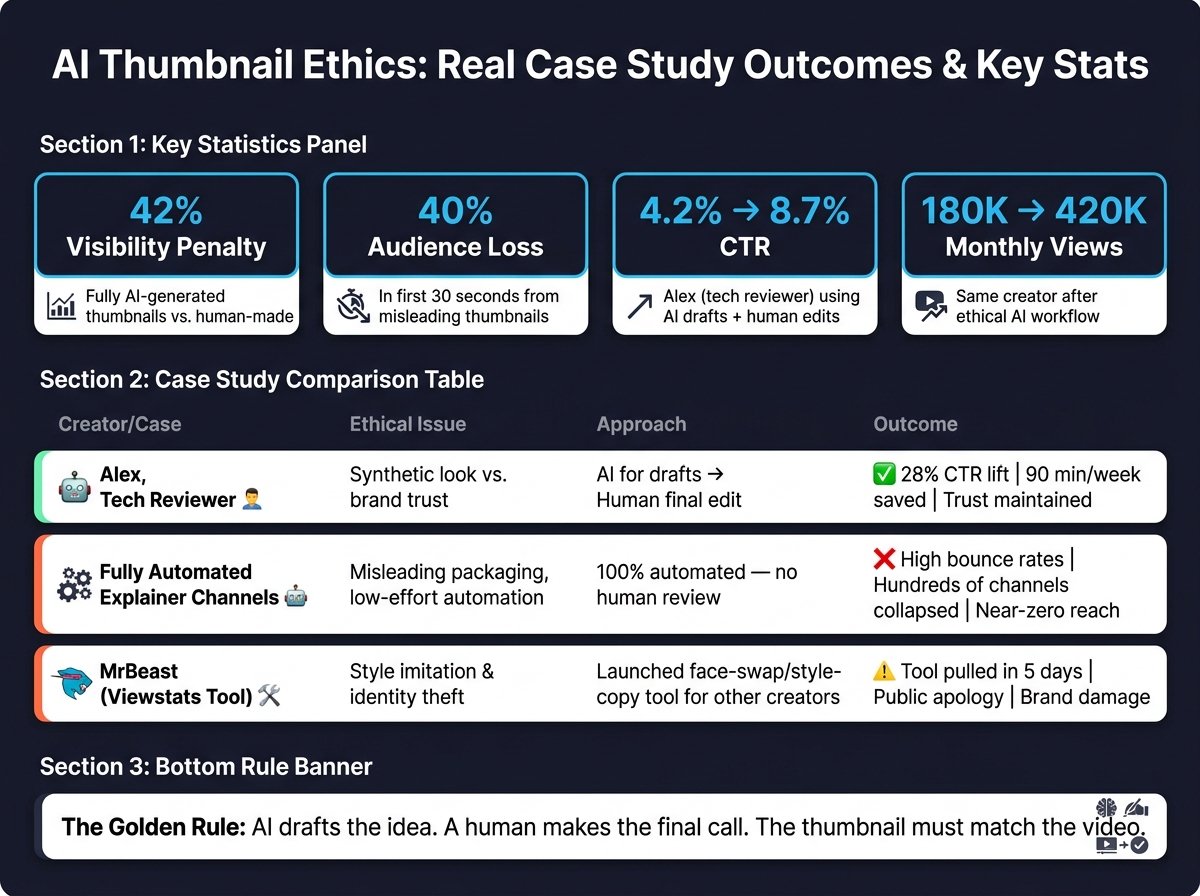
AI Thumbnail Ethics: Case Study Outcomes & Key Stats
Short-term clicks vs. long-term credibility
These ethical calls matter because performance today depends on what happens after the click, not just CTR. A thumbnail can win the click, sure. But if the video doesn't match the promise, viewers leave fast. That quick bounce tells the platform something went wrong, and reach can drop soon after.
"If people click, watch 20 seconds, then click away to find something better, the algorithm learns you're misleading. Your reach decays." - Dan Kim, Founder, Hooksnap
The case data points in the same direction. Fully AI-generated thumbnails come with a 42% visibility penalty compared with human-made ones. Misleading thumbnails also drive a 40% audience loss in the first 30 seconds. And when AI thumbnails do work well, the upside is usually more modest than the hype suggests: a realistic CTR lift is about 25% to 40%, not the instant doubling some tools sell.
Ethical risks, safeguards, and outcomes compared
Put side by side, the pattern is hard to miss. Creators did better when a person stayed in control, or when AI was used only on their own material. The ones that gave the whole job to automation, or used AI to mimic other people, took the hit.
| Case | Ethical Issue | Creator Choice | Safeguard Used | Audience/Brand Outcome |
|---|---|---|---|---|
| Alex (tech reviewer) | Synthetic look vs. brand trust | Used AI for fast drafts; human made final edits | Kept real face and video frames; added text and cutouts by hand | 28% CTR lift; 90 minutes/week saved; viewer trust maintained |
| Fully automated explainer channels | Misleading packaging; low-effort automation | Fully automated scripts, voices, and thumbnails | None | High bounce rates; hundreds of channels collapsed; near-zero reach |
| MrBeast (Viewstats) | Style imitation and identity theft | Launched tool to swap faces/styles of other creators | Pledged to limit face-swaps to the user's own face only | Massive creator backlash; public apology; brand damage |
All three cases point to the same takeaway: AI works better when people keep editorial control. Once the line shifts into copying others or handing everything to automation, trust drops and reach tends to follow.
"YouTube pioneered online pile-on culture... AI in the creator economy is incredibly controversial right now. Many do view it as theft." - Jess Maddox, Associate Professor at the University of Alabama
That makes a repeatable review process necessary before publishing.
A practical ethical workflow for AI thumbnails
A pre-publish review checklist
The simplest way to deal with imitation, consent, and too much automation is to use a short pre-publish checklist.
| Check | Question | Risk |
|---|---|---|
| Accuracy | Does this AI scene actually appear in the video? | Lower satisfaction and reach |
| Consent | Do I have rights to every face or asset shown? | Complaints or takedowns |
| Originality | Is this a new expression, not a copy of another creator's exact design? | Copyright or brand damage |
| On-brand | Does the output match my established visual identity? | Audience distrust |
Start with accuracy. The thumbnail needs to match the video, or people will click, feel misled, and leave early. That kind of drop-off can hurt reach.
"The real test is whether your thumbnail honestly represents what viewers will find in your video." - Dan Kim, Founder, Hooksnap
Consent also needs a manual check. Only use faces and assets you own or have clear permission to use. AI can draft fast, but it can't confirm rights for you.
For originality, map out the thumbnail structure first, then rebuild it with your own assets. If the result leans on another creator's exact layout or color palette, scrap it and start over.
How AI tools can support responsible design
After those checks are done, AI can help move the draft along.
AI is most useful for rough drafts and final touch-ups. A person should still approve the last image. That's the line that matters.
Tools should help the workflow, not make the last call. ThumbnailCreator fits that setup with AI generation, text editing, and object swapping, while the creator still approves the final image.
"A generic, interchangeable 'shocked creator face' is easier to fake than a distinctive, on-brand identity." - Dan Kim, Founder, Hooksnap
YouTube does not require disclosure labels for AI-generated thumbnails, but the image still needs to represent the video honestly.
Conclusion: The rules that matter most
Across these case studies, three rules kept showing up.
Creators who use AI as a drafting assistant, not a decision-maker, tend to keep their audience and grow their channels. But when creators hand over the whole job, things can go sideways fast: CTR can drop, viewer trust can slip, and in the worst cases, channels can get strikes or even be terminated. Those removals happened because of low-quality automation, not because AI was used at all.
A few rules stand out:
- Keep faces real
- Get permission for every face and asset
- Don’t copy another creator’s style
Each one points back to the same idea: human editorial control. That was the one guardrail that showed up in every case that worked. And it matters for a simple reason: trust drives retention.
The main rule is simple: the thumbnail has to match the video. Misleading images can cause people to leave early, and that weakens reach.
ThumbnailCreator works best when a human stays in the final seat. Use AI for draft options and cleanup, then make the last call yourself. AI can help with thumbnail creation, but the final decision belongs to you.
FAQs
How much human editing is enough?
A bit of human editing goes a long way. It helps the thumbnail match the video and keeps viewer trust intact.
AI can help with idea generation and quick edits like background removal, color grading, and contrast adjustments. But human oversight still matters. Someone needs to check the emotion on the face, make sure the text is easy to read, and confirm the layout is clear at a glance.
Do a squint test at 120 pixels to see how it looks on mobile. Then make a few manual tweaks so the thumbnail stays honest and matches what the video actually delivers.
What counts as copying another creator’s style?
It slips into unethical copying when you go past general inspiration and start duplicating another creator’s brand look piece by piece. That means using the same pose, the same framing, the same background, and the same color palette - or taking an existing layout and only changing the text and faces.
The better approach is to study broad design ideas, like contrast or hook placement, then make thumbnails that feel original and fit your own brand.
Can I use AI face swaps in thumbnails?
Yes. AI face swaps can help when you want to test different emotional looks, like turning a neutral expression into a shocked one to see if it improves click-through rates.
ThumbnailCreator can help keep your look consistent across different thumbnail versions. That said, it’s still smart to match your actual appearance as closely as possible so viewers recognize you and keep trusting what they see.