

Competitor Thumbnails: Trends in Emotions
Emotional expressions in thumbnails can significantly boost YouTube click-through rates (CTR). Here's what you need to know:
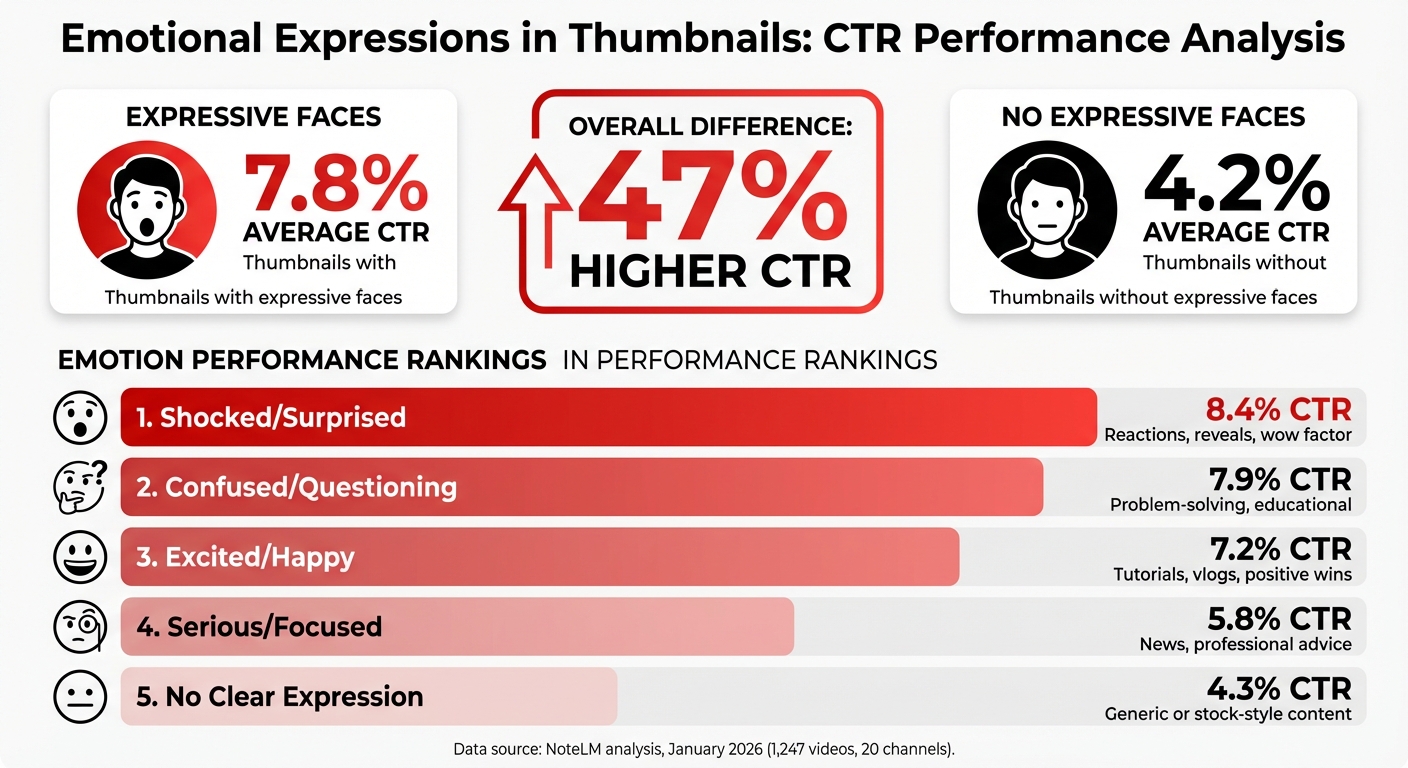
- Thumbnails with expressive faces perform better, achieving a 47% higher CTR than those without expressions.
- Top emotions: Surprise leads with an 8.4% CTR, followed by happy (7.2%), confused (7.9%), and serious (5.8%).
- Design trends (2020–2025): Faces are now 35% larger, text usage has dropped by 40%, and color saturation is up by 28%.
- AI tools like ThumbnailCreator simplify thumbnail design with features like face swapping, background editing, and optimized layouts.
Key takeaway: Use bold designs, focus on emotional expressions, and ensure clarity on mobile screens. AI tools can save time and improve results.
YouTube Thumbnail Emotions CTR Performance Comparison 2026
1. Competitor Emotional Thumbnail Trends
Emotional Diversity
Top YouTube creators tend to stick to specific emotional expressions in their thumbnails rather than showcasing a wide range. These choices often align with their content niche. A study conducted in September 2024 by Kapwing and NeoMam Studios, using Amazon Rekognition AI, revealed some fascinating trends. For example, SSSniperWolf used a "surprised" expression in 70% of her thumbnails, while Mark Rober leaned on "happy" expressions in 57.14% of his. Ludwig frequently opted for "confused" expressions (60%), and the Stokes Twins favored "fear" in 47.37% of their thumbnails.
The genre of content also influences emotional choices. Travel videos had the highest percentage of "happy" faces at 53.69%, while Fitness & Sports content often featured "calm" expressions (37.38%). Gaming content stood out with "surprised" expressions leading at 28.14%, alongside over 10% usage of dramatic & intense emotions like "anger" or "fear." Interestingly, "sadness" (1.50%) and "disgust" (0.90%) were the least used emotions across all thumbnails analyzed. These choices aren't just aesthetic - they directly impact engagement, helping creators connect with their audience more effectively.
Performance Impact (CTR)
The emotional expression in a thumbnail plays a huge role in driving clicks. In January 2026, NoteLM analyzed 1,247 videos from 20 channels and found that thumbnails with expressive faces had an average click-through rate (CTR) of 7.8%, compared to just 4.2% for thumbnails without expressive faces - a 47% difference. Among the emotions, "shocked/surprised" led the pack with an 8.4% CTR, followed by "confused/questioning" at 7.9%, "excited/happy" at 7.2%, and "serious/focused" at 5.8%. Thumbnails with no clear expression lagged behind at 4.3%.
| Expression Type | Average CTR (2026 Data) | Primary Use Case |
|---|---|---|
| Shocked/Surprised | 8.4% | Reactions, reveals, "wow" factor |
| Confused/Questioning | 7.9% | Problem-solving, educational |
| Excited/Happy | 7.2% | Tutorials, vlogs, positive wins |
| Serious/Focused | 5.8% | News, professional advice |
| No Clear Expression | 4.3% | Generic or stock-style content |
Eric Lu, Co-Founder of Kapwing, shared his thoughts on the findings:
I originally thought that angry or sad video previews would get the most clicks, but this data shows that successful YouTube creators prefer using a happy or surprised face in their thumbnails.
Ease of Implementation
With these insights, creating effective thumbnails has become easier than ever, thanks to modern tools. Even creators with minimal design skills can produce thumbnails that resonate with viewers. For optimal results, ensure the subject's face takes up 30–40% of the thumbnail space to remain clear on mobile screens (168×94 pixels). Use 3–5 bold, high-contrast words and direct the subject's gaze toward a key element in the image.
Avoid placing important elements in the bottom-right corner, as the video timestamp will obscure them. Additionally, steer clear of fake emotional cues. While these might temporarily boost CTR by 40–60%, they can lead to a drop in long-term retention and recommendations by over 80%. These strategies can help creators balance authenticity with engagement, ensuring their thumbnails draw clicks while building trust with their audience.
sbb-itb-b59debf
2. ThumbnailCreator
Emotional Diversity
ThumbnailCreator takes the latest emotional trends and turns them into practical tools for creators. The platform's AI-powered editor incorporates design strategies like using larger, more prominent faces and boosting color saturation to grab attention. Want to try the "surprised" look that dominates 26.95% of top thumbnails? Or maybe the "happy" expression, which appears in 26.65%? ThumbnailCreator makes it easy to experiment with these emotional styles, helping creators refine their thumbnails for better performance.
Performance Impact (CTR)
Thumbnails featuring expressive faces can achieve a 47% higher click-through rate (CTR) compared to those without. ThumbnailCreator helps creators apply proven techniques, like ensuring faces take up 30–40% of the thumbnail space, and using high-contrast colors to boost visibility by 40%. These small but impactful adjustments can make a big difference, especially since emotional expressions are a key factor in separating professional-looking thumbnails from amateur ones.
Ease of Implementation
Designing eye-catching thumbnails is now simpler than ever with ThumbnailCreator’s user-friendly features. The AI automates tasks like background creation and color adjustments, so even creators without design experience can produce polished results. With AI's role in thumbnail creation growing from 0% in 2020 to 23% by 2025, this tool meets the demand for smarter, faster workflows. It also optimizes text content, reducing the average word count from 5.8 to 3.4, which is perfect for mobile users - who make up over 70% of YouTube traffic. Plus, features like face swapping and object swapping let creators test different emotional expressions quickly, ensuring their thumbnails resonate with viewers.
How to Make High-CTR Thumbnails with Facial Expressions|Vmake Emotional Thumbnail Tutorial

Pros and Cons
When comparing manual strategies to an AI-driven approach, it's clear that each has its own advantages and drawbacks, especially when it comes to competitor analysis and thumbnail creation.
Manual competitor analysis allows for complete creative control. It enables you to replicate successful styles, such as the "MrBeast-style" expressive faces that viewers often associate with engaging, high-quality content. Emotions like happiness and surprise tend to connect with audiences across the globe. However, this process is incredibly time-intensive, often requiring hours of work and multiple days of A/B testing vs gut feeling decisions. Additionally, relying too heavily on a single trend - like the "surprised face" - can lead to viewer fatigue or make your content feel less genuine.
On the other hand, ThumbnailCreator’s AI-driven solution takes care of the tedious tasks, such as removing backgrounds, optimizing layouts, and adjusting colors - all in just minutes. The platform also applies proven benchmarks, such as limiting text to 3–5 words and ensuring that faces make up 30–40% of the thumbnail. These strategies have been shown to increase click-through rates (CTR) by as much as 47%. However, while these AI-generated thumbnails are efficient and effective, they may sometimes lack the personal touch that niche audiences - like gamers or documentary enthusiasts - might prefer.
Here’s a quick breakdown of the trade-offs:
| Feature | Manual Competitor Trends | ThumbnailCreator (AI-Driven) |
|---|---|---|
| Emotional Range | Focuses on 1–2 "safe" emotions (e.g., Happy, Surprised) | Incorporates all 7 emotional categories using data analysis |
| CTR Impact | Relies on "YouTube Face" trends for a 35–50% CTR increase | Optimizes design elements to boost CTR by up to 47% |
| Ease of Use | Requires extensive A/B testing and manual design work | Automates the process for faster results |
| Consistency | Can result in inconsistent visuals and branding | Delivers systematic, brand-aligned designs that reduce visual clutter |
If you have the time and the skills to adapt to ever-changing trends, the manual approach might suit your needs. But for those prioritizing speed, consistency, and data-driven outcomes, ThumbnailCreator’s AI-powered tools take much of the trial-and-error out of the equation. The choice ultimately depends on your workflow and what your audience expects.
Conclusion
Data shows that emotional thumbnails make a big difference. Shocked or surprised expressions lead the way with an average CTR of 8.4%, while happy faces follow at 7.2%. Trends also reveal that larger faces (up 35% since 2020), less text (down 40% in the same timeframe), and bolder color saturation are what stand out in crowded feeds. Ignoring these patterns could mean losing visibility.
Here’s what works: use 3–5 bold, high-contrast words, ensure faces take up 30–40% of the thumbnail, and apply a squint test to check its clarity on mobile screens.
While applying these principles manually can take hours, tools like ThumbnailCreator simplify the process. It handles tasks like background removal, boosting color saturation levels, enlarging faces, and optimizing layouts in just minutes instead of days. The platform uses proven benchmarks, so you’re not left guessing which emotions or colors will deliver the best results.
The choice between manual adjustments and AI-powered efficiency depends on your workflow. For creators testing multiple thumbnails - like comparing shocked versus happy expressions across videos - ThumbnailCreator makes it easy to create variations instantly. This frees up time to focus on creating content rather than fine-tuning designs. Emotional trends are clear, and the key to success is consistent, fast execution. Stick to these steps, and you'll keep your audience engaged.
FAQs
Which emotion works best for my channel niche?
Thumbnails that showcase expressive human faces with emotions like happiness or surprise often resonate strongly with viewers. These emotions can spark curiosity and create an emotional bond, making your content feel more relatable. The key is to align the emotion with your channel's niche and audience, ensuring your thumbnails are both engaging and click-worthy.
How can I quickly A/B test thumbnail emotions?
YouTube's 'Test & Compare' feature is a great way to figure out which thumbnail grabs the most attention. Here's how you can use it effectively: upload up to three thumbnail variations, each showcasing a different emotional expression - like a happy face, a surprised look, or something else that stands out.
Let the test run for about two weeks to gather enough data for meaningful insights. If you're short on time, you can speed up the process by creating multiple thumbnail variations quickly using design tools or simple edits. Once the test is complete, analyze the results to see which emotion resonates best with your audience by driving the highest click-through rate and engagement.
How can I stay authentic without clickbait?
When creating thumbnails, focus on honesty and delivering real value rather than relying on clickbait tactics. Use genuine facial expressions, clear visuals, and concise text that accurately reflect the content of your video. Avoid over-the-top exaggerations or misleading elements - these can damage trust with your audience. Instead, aim to spark curiosity by using high contrast and expressive visuals. This approach not only grabs attention but also builds trust over time, helping you grow your audience in a way that's both engaging and authentic.