

How Gaze Direction Impacts Thumbnail Performance
Want to boost your YouTube thumbnail performance? It all comes down to gaze direction. Here's the key takeaway: where the subject in your thumbnail is looking can either grab attention or guide viewers toward your video's message.
- Direct gaze: Builds trust and connection, increasing click-through rates (CTR) by up to 67%.
- Indirect gaze: Directs attention to key elements like text or objects, boosting engagement by up to 50%.
- Emotional expressions: Surprise or shock faces outperform neutral ones, averaging higher CTRs.
- Custom thumbnails: Far outperform auto-generated ones, improving CTR by 154%.
The right gaze direction depends on your content type. Direct gaze works for personal connections, while indirect gaze is better for highlighting details like products or text. Testing different designs ensures your thumbnail stands out and matches viewer expectations.
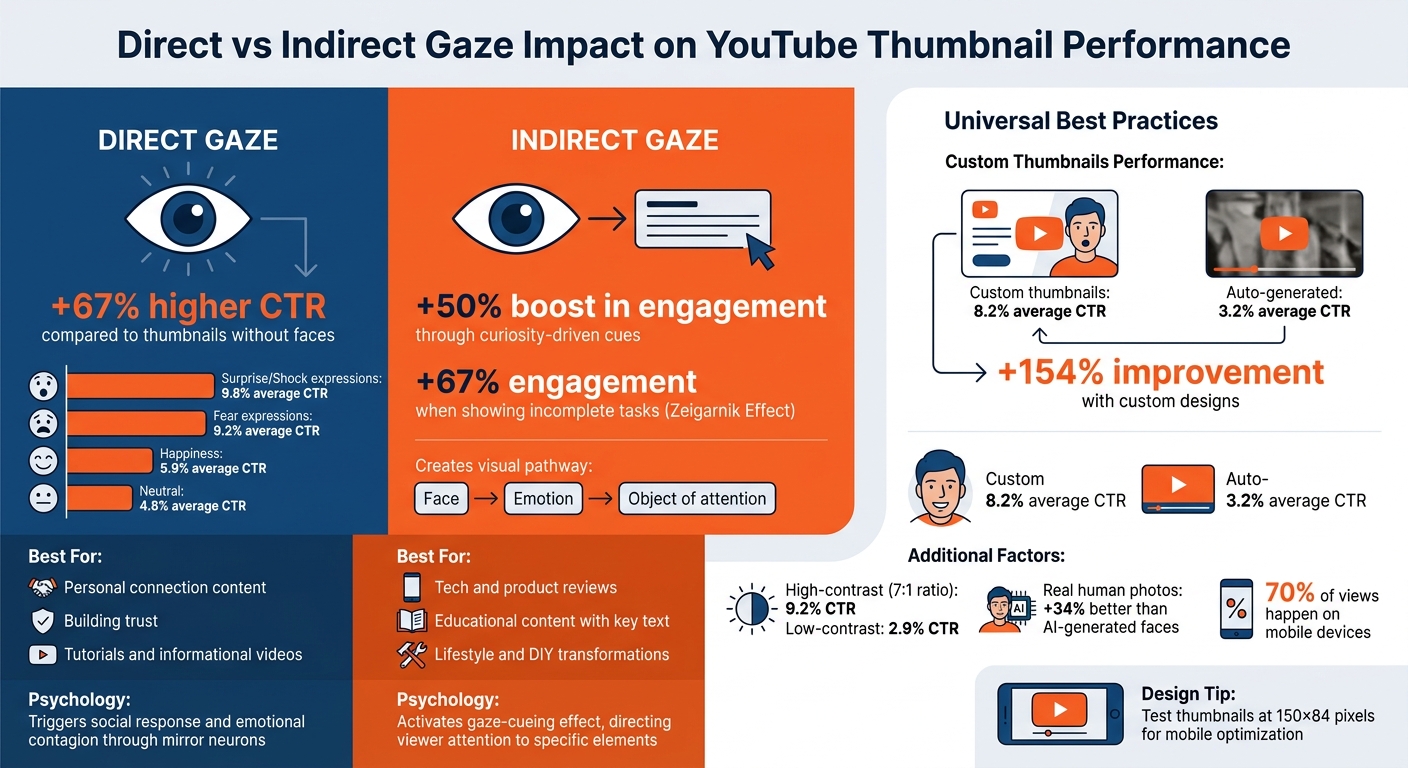
Direct vs Indirect Gaze Impact on YouTube Thumbnail CTR Performance
How Direct Gaze Affects Thumbnail Performance
The Psychology Behind Direct Gaze
When a thumbnail features someone looking directly at the viewer, your brain reacts almost instantly. This is thanks to the fusiform face area, a part of your brain that processes faces faster than nearly anything else. It’s like your brain is hardwired to notice faces before anything else on the screen.
Direct eye contact triggers a social response - your brain interprets it as a kind of digital handshake. It feels personal, like the content is speaking directly to you. This isn’t random; it’s rooted in human evolution. Recognizing faces and expressions helped early humans assess social situations quickly, whether for opportunities or threats.
Another fascinating factor is emotional contagion. When you see an emotional expression in a thumbnail, your mirror neurons kick in, making you feel a version of that emotion. For example, a surprised face might spark curiosity, while a confident expression can build trust. This subtle emotional priming can have a huge influence on whether you decide to click.
CTR Data for Direct Gaze Thumbnails
The stats back up the science. Thumbnails with direct eye contact see a 67% higher CTR (click-through rate) compared to those without faces. Add emotional expressions, and the results are even more impressive. For instance, surprise or shock expressions average a 9.8% CTR, while fear-based expressions come in at 9.2%. These emotions grab attention more effectively than happiness (5.9% CTR) or neutral expressions (4.8% CTR) because your brain prioritizes the unexpected.
Custom thumbnails also outperform auto-generated ones by a huge margin. Channels using well-designed thumbnails average an 8.2% CTR, compared to just 3.2% for auto-generated thumbnails - a 154% improvement. Real photos of humans with strong emotional expressions also perform better than AI-generated faces by 34%, largely because AI-generated faces can sometimes feel unsettling due to the "uncanny valley" effect.
Contrast plays a big role, too. High-contrast thumbnails (with a 7:1 ratio or higher) average a 9.2% CTR, while low-contrast designs drop to just 2.9%. This is because your brain’s peripheral vision is drawn to high-contrast elements first, making bold, clear designs essential for grabbing attention during fast scrolling.
That said, direct gaze isn’t always the best option.
When Direct Gaze Doesn't Work
Sometimes, direct gaze can backfire. In September 2023, MrBeast - YouTube’s most-subscribed creator - experimented with his thumbnails and found a surprising result. Simply closing his mouth in the images led to higher watch times across all his videos.
"I closed my mouth on all my thumbnails and the watch time went up on every video lol. We must not rest until mouths are closed in everyone's thumbnails." - MrBeast, YouTuber
This highlights an important point: oversaturation. When direct gaze or specific facial expressions become too common, they lose their impact. Your brain gets used to seeing the same thing, making it easier to scroll past without stopping.
Direct gaze can also be a distraction in thumbnails that need to highlight a specific object or text. In cases like these, the face might draw too much attention to itself, overshadowing the key message. For example, science YouTuber Mark Rober often keeps his face small in the frame, usually with a calm or neutral smile (used in 57.14% of his thumbnails). This approach adds a human element without taking focus away from the "wow factor" of his experiments.
Different genres also have different needs. In Fitness & Sports content, calm expressions appear in 37.38% of thumbnails. While fear or shock can drive quick clicks, overusing exaggerated emotions risks eroding trust if the content doesn’t deliver on the thumbnail’s promise.
sbb-itb-b59debf
How Indirect Gaze Influences Viewer Behavior
Directing Attention with Indirect Gaze
When someone in a thumbnail looks away, your brain instinctively follows their gaze. This natural reaction, known as gaze cueing, directs focus, making it an effective way to guide what viewers notice first.
This creates a visual order: face, emotion, and then the object of attention.
"When we see a face looking at something, our attention automatically follows the direction of the eyes." - Ventress
Indirect gaze also triggers curiosity. When a thumbnail shows someone looking at an incomplete task or a mysterious object, it leaves viewers wanting to know more. This taps into the Zeigarnik Effect, where unfinished scenarios stick in our minds. For instance, a mechanic eyeing a loose bolt is far more intriguing than one who’s completed the repair. This approach, when done well, can boost engagement by 67%.
While direct gaze fosters a personal connection, indirect gaze is better at emphasizing specific elements like text overlays, products, or focal points. Using curiosity-driven visual cues, such as indirect gaze, can increase click-through rates (CTR) by up to 50%.
This technique works across a range of content types.
Content Types That Benefit from Indirect Gaze
Some genres are particularly well-suited to indirect gaze. For example:
- Tech and product reviews: The subject’s gaze helps highlight the product, keeping the focus on it rather than the creator.
- Educational and explanatory videos: Indirect gaze directs viewers to key text or results, emphasizing the video’s main takeaway.
- Lifestyle and DIY content: It connects the creator to the transformation or object they’re featuring, adding depth to the story.
A study on Facebook ads revealed that consumers were more likely to click on ads featuring models with an averted gaze compared to direct gaze. Why? Because indirect gaze draws viewers into the narrative, encouraging them to imagine themselves as part of the scene - especially for topics like travel, food, or lifestyle.
"Averted gaze draws the viewers in, encourages them to imagine themselves as part of the ad narrative, and makes them feel more engaged." - Rita Ngoc To and Vanessa M Patrick, Researchers
However, for tutorials or informational content, direct gaze often works better. It builds trust and creates a sense of personal interaction, much like a one-on-one conversation. But when the goal is to highlight a specific detail - like a shocking number, a dramatic transformation, or a product feature - indirect gaze ensures that detail grabs attention during the 2.6 seconds viewers typically spend on a thumbnail.
Best Practices for Optimizing Thumbnail Gaze Direction
Matching Gaze Direction to Thumbnail Elements
Thumbnails work best when the subject’s gaze creates a visual guide that draws viewers to specific elements. For this, try placing the subject’s face on either the left or right third of the thumbnail, following the Rule of Thirds. This positioning leaves space for the gaze to direct attention to key elements, like text or objects, while avoiding the bottom-right corner where YouTube’s timestamp overlay appears. For example, if you’re creating a product review thumbnail, position the subject on the left and have them look toward the product. In a tutorial thumbnail, direct the gaze toward an eye-catching text overlay.
The way our brains scan thumbnails naturally follows a Z-pattern - from the top-left to the top-right, then diagonally to the bottom-left, and finally to the bottom-right. Aligning the subject’s gaze with this flow can help guide attention effectively. When designing, always check how the thumbnail looks at a reduced size, such as 150×84 pixels. If the gaze and its target aren’t clear at smaller sizes, simplify the layout for better results.
Testing Different Gaze Directions
Once you’ve created a thumbnail with a clear visual path, testing different gaze directions becomes essential. YouTube’s Test & Compare feature allows you to upload up to three thumbnail variations and measure their performance based on watch-time share. To gather accurate data, run each test for at least 14 days and aim for a minimum of 500 impressions per variation.
Experiment with different approaches - create one version with the subject looking directly at the camera and another where the gaze is directed toward a key element like text or a product. Pay close attention to both click-through rate (CTR) and viewer retention. A high CTR with low retention might mean the thumbnail promises more than the content delivers, potentially driving viewers away. For instance, Ali Abdaal ran a similar test and saw his CTR jump from 3.2% to 7.8%.
"Your thumbnail is a promise. Your video is the fulfillment. If they don't match, viewers leave and the algorithm punishes you." – Paddy Galloway
After the testing period, review the data, especially from the final 24–48 hours, to make your decision. Remember, with 70% of YouTube views happening on mobile devices, designs that look great on desktop might not work as well on smaller screens.
Using AI Tools to Create Optimized Thumbnails
AI tools like ThumbnailCreator (https://thumbnailcreator.com) can make experimenting with gaze direction easier. These tools let you generate multiple variations, including direct and indirect gazes, while maintaining a consistent visual style. Features like face swapping and object swapping allow you to test different layouts without starting from scratch.
AI analyzers can also evaluate how effectively an indirect gaze points viewers toward text or a product. They can even spot trends in your niche to identify the most engaging gaze directions. Since boosting your CTR from 4% to 8% can result in 3–5× more impressions, using AI to refine gaze direction can directly impact how widely YouTube promotes your video. By letting AI handle the technical adjustments, you can focus on ensuring the thumbnail aligns with your content’s message.
How Do Artists Direct the Gaze in Composition?
Conclusion
Gaze direction in thumbnails plays a powerful role in grabbing viewers' attention. When a subject makes direct eye contact, it triggers an almost instant connection in the viewer's brain, potentially increasing click-through rates by as much as 35%. On the other hand, an indirect gaze taps into the gaze-cueing effect, subtly steering viewers' eyes toward key elements like text or curiosity-driven visuals that emphasize your video's value.
The combination of intentional gaze placement and a clear visual hierarchy is what sets high-performing thumbnails apart from generic, auto-generated ones. Research shows that placing a subject's face prominently in the frame and directing their gaze toward critical elements creates a subconscious visual pathway that viewers process in milliseconds. This approach reinforces the importance of strategic design choices in thumbnail performance.
To refine these strategies, A/B testing vs gut feeling is essential. Testing different thumbnail designs with enough impressions ensures statistical reliability, while tracking metrics like watch time alongside CTR provides a fuller picture of performance. After all, thumbnails that attract clicks but fail to retain viewers can negatively impact your channel's overall success.
For creators looking to streamline this process, tools like ThumbnailCreator make it easier to experiment with various gaze directions, swap out faces or objects, and preview designs optimized for mobile - all without needing advanced design skills. By optimizing gaze direction, you could see CTR improvements of up to 154%. Treat every thumbnail as an opportunity to test and improve, rather than a static final product, to maximize your video's potential.
FAQs
Should my thumbnail subject look at the camera or at the text/product?
Having the subject of your thumbnail make direct eye contact with the camera can create a powerful connection with potential viewers. Expressive facial expressions combined with direct eye contact are known to grab attention and evoke emotions, which can significantly improve click-through rates.
How do I A/B test gaze direction without hurting my video’s performance?
To test how gaze direction affects your video's performance without disrupting its overall success, conduct controlled experiments using different thumbnail designs. Tools like YouTube's "Test & Compare" feature or ThumbnailCreator allow you to split your audience into groups and measure the click-through rates (CTR) for each variation. Make sure all other elements, like titles and descriptions, remain unchanged. Run the test for 7–14 days and aim for at least 1,000 impressions per variation to ensure the results are reliable.
What facial expression boosts CTR without feeling like clickbait?
Facial expressions that show happiness or surprise can significantly improve click-through rates (CTR). These emotions draw people in by projecting positivity and sparking curiosity, encouraging them to interact with your content - without feeling like they're being baited.