

How Video Length Affects YouTube Engagement
There is no single best YouTube video length. What matters is this: use the shortest length that fully covers the topic. In most cases, short videos win on retention and completion, while long videos win on total watch time.
Here’s the simple takeaway:
- Under 5 minutes: aim for about 65%–75% retention
- 5–15 minutes: about 40%–60% retention can still be solid
- Over 15 minutes: even 35%–45% retention may work if watch time stays high
- A 3-minute video at 70% retention creates 2.1 minutes of watch time
- A 20-minute video at 25% retention creates 5 minutes of watch time
So if you only look at retention %, you can misread performance. You should also monitor your thumbnail CTR benchmarks to see how many people are choosing to watch in the first place.
What I’d focus on first in YouTube Analytics:
- Watch time
- Average view duration
- Audience retention
- Completion rate for shorter videos
The big idea: short videos need a fast payoff, and long videos need structure that keeps people watching. If your intro drags, your retention drops. If your middle gets slow, viewers leave. If each section earns its time, longer videos can still do well.
A quick comparison:
| Video length | What usually matters most | Common target |
|---|---|---|
| Under 5 minutes | Retention and completion | 65%–75% retention |
| 5–15 minutes | Pacing and average view duration | 40%–60% retention |
| Over 15 minutes | Watch time per viewer | 35%–45% retention |
I’d also match length to format:
- Simple how-tos: 2–5 minutes
- Multi-step explainers: 8–12 minutes
- Commentary or reviews: 6–20 minutes
- Deep dives: 20–40+ minutes
The short version? Don’t chase a magic number. Pick a length your topic can support, cut weak intros, watch your drop-off points, and judge each video by the right metric for its runtime.
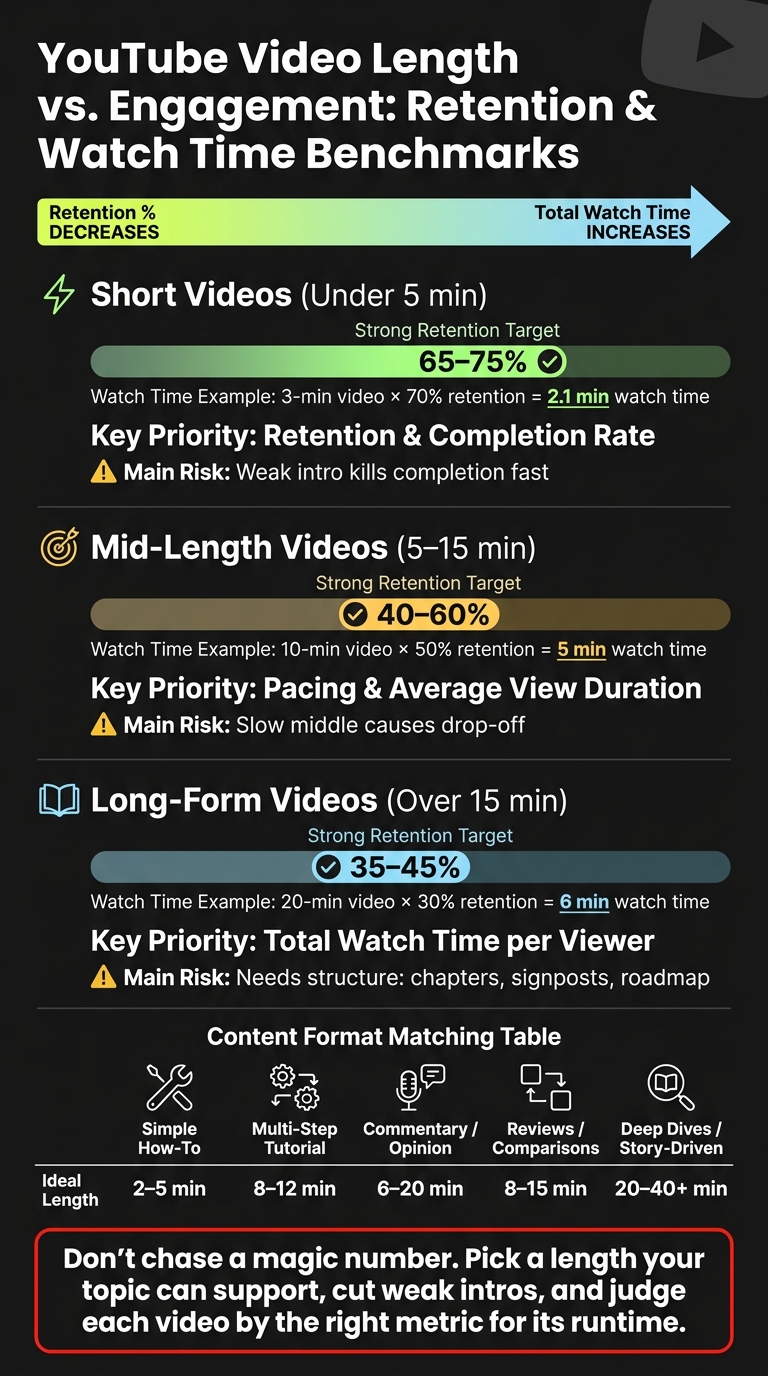
YouTube Video Length vs. Engagement: Retention & Watch Time Benchmarks
What's The Right Length For Your Videos In 2026?
sbb-itb-b59debf
How Engagement Changes as Videos Get Longer
As videos get longer, retention percentage usually drops, while total watch time per viewer goes up. That trade-off is the whole game here. A longer video can still do well even if the retention percentage looks lower at first glance.
That’s why benchmarks need to change based on video length. It helps to split performance into short, mid-length, and long-form groups.
| Length Band | Typical Strong Retention | Watch Time per Viewer | Main Tradeoff |
|---|---|---|---|
| Under 5 minutes | 65–75% | About 2–2.5+ minutes on a 4-minute video | High completion pressure; weak intros are costly |
| 5–15 minutes | 40–60% | About 4–6+ minutes on a 10-minute video | Depth is possible, but pacing and structure matter |
| Over 15 minutes | 35–45% | About 8 minutes on a 20-minute video | Lower retention percentage, but high total watch time |
Here’s the simple math: a 6-minute video at 80% retention gives you about 4.8 minutes of watch time per viewer. A 20-minute video at 30% retention gives you 6 minutes. So even though a much smaller share of viewers stayed, the longer video still produced more total watch time.
That’s why retention percentage by itself can be a bad way to judge long videos.
Short videos are judged on speed. Longer videos are judged on staying power.
Under 5 minutes: fast payoff and high completion pressure
Short videos live or die in the opening seconds. Put the main value in the first 15–30 seconds. If you spend that time on a slow personal intro, a long channel plug, or a vague setup, you burn through a tiny time budget fast.
Cut that fluff, and completion rates tend to climb. Leave it in, and a 3-minute video can easily sink below 50% retention - a weak result for this length band.
Strong short videos usually aim for 65–75% retention. The standouts can push past 75%.
5 to 15 minutes: balancing depth and drop-off
This range is a sweet spot for tutorials, reviews, and explainers. You have enough room to build an idea, but you’re not asking for too much time up front.
The main danger here is the slow middle. Maybe the pacing drifts. Maybe a tangent drags on. Maybe the video starts saying the same thing twice. That’s often where people bail.
In YouTube Studio, retention graphs often show a sharp dip at the first big transition, sometimes around the 1–2 minute mark, when viewers make a stay-or-go choice. A smart fix is to show the payoff early. Lead with the result or key insight, then walk through how to get there. That can keep more viewers with you through that make-or-break stretch.
Once you go past 15 minutes, structure matters just as much as topic strength.
Over 15 minutes: lower retention can still win with strong watch time
A 30-minute deep dive with 35% retention still produces 10–12 minutes of watch time per viewer. Those extra minutes matter to YouTube, which is why well-structured long videos can still do well in recommendations even when the retention percentage looks just okay.
This format works best for educational walkthroughs, detailed commentary, and story-driven videos where the subject actually needs the runtime.
To help viewers stay with you, use:
- Chapters
- Verbal signposts
- A clear roadmap at the start
Those cues make it easier for people to re-engage instead of leaving.
Why Videos of Different Lengths Perform Differently
The gap between short and long video performance usually comes down to one thing: viewer commitment. Every runtime asks the viewer for a different amount of time, attention, and patience. Long videos tend to fail when the value per minute doesn't match the commitment they ask from people watching.
Longer videos ask for more viewer commitment upfront
Longer videos ask people to commit more right away. That means the first 30 to 60 seconds need to prove, fast, that the video is worth sticking with. If the opening doesn't make the payoff clear—or if you've made common thumbnail mistakes—viewers bail.
Think of it this way: clicking on a 12-minute video feels different from clicking on a 2-minute one. With the longer video, viewers want a reason to trust that their time won't be wasted.
Topic depth and information density shape retention
Not every topic deserves a long runtime. A single-purpose topic, like a basic how-to or a one-feature product demo, can usually be covered in under 5 minutes. Once you stretch it past that point, you're not adding more value. You're just lowering the information density.
Some topics do need more room. A multi-step tutorial, a detailed product comparison, or a case study with real context can't always be squeezed into a short format. In those cases, each section needs to add something distinct and necessary. When that happens, viewers are more willing to accept a lower retention rate because the value per minute still feels high.
A simple gut check helps here:
- How many sections does this topic actually need?
- Does each section earn its runtime?
Pacing, structure, and payoff affect where viewers drop off
Retention graphs make pacing issues hard to miss. Repeated points, slow transitions, and long stretches without new information often lead to sharp drop-offs at specific timestamps. Those dips usually show the exact moment the video stopped giving viewers something new.
Strong pacing looks different. Instead of a steep fall, you tend to see a gradual decline. That's usually a sign the video keeps moving, previews what's coming next, signals transitions, and delivers small payoffs along the way.
Once you understand why length changes retention, the next move is matching runtime to the kind of content you're making.
How to Choose the Right Length for Your Content Type
Match runtime to the format, not to some magic number. People judge each format by a simple tradeoff: How fast does this give me something useful compared with how much time it asks from me? That’s why these ranges only make sense when they line up with the job the format needs to do.
Tutorials and explainers: short enough to stay focused, long enough to be complete
Simple tasks with one clear outcome usually work best in 2–5 minutes. If the topic has several steps, 8–15 minutes can work well too, as long as every part helps the viewer get to the promised result.
Cutting steps hurts trust. Dragging things out hurts retention. A simple way to judge length is to map the fewest steps someone needs to reach a clear outcome, estimate the natural runtime, and trim anything that doesn’t help move that result forward. If the steps are complete and tight, the runtime is probably in the right place.
Commentary, reviews, and opinion videos: match length to the strength of your angle
A lighter opinion video may land best at 6–10 minutes, while a fuller product review that covers context, proof, and long-term use can earn 12–20 minutes.
The main issue usually isn’t length. It’s repetition. If you repeat the same reaction across several clips, spend too long on setup that doesn’t matter, or keep returning to a point you already made, retention tends to drop hard. Each section should do one of three things: add proof, add context, or sharpen the verdict. If it does none of those, cut it.
Deep dives and story-driven videos: earn the extra runtime with clear structure
Long-form analysis and narrative videos and vlogs can work at more than 20 minutes, but they have to earn that time with structure. Retention benchmarks show that 20–60 minute videos typically see 30–45% average percentage viewed. That may sound low at first, but it can still drive a lot of total watch time.
What keeps people watching isn’t just a big payoff at the end. You need to give them a new reason to stay every few minutes. Chapter markers, clean section transitions, and well-spaced moments of insight can help reduce drop-off. Without that backbone, even an interesting topic can lose viewers bit by bit after the midpoint. Once the length matches the format, the next thing to work on is the opening and pacing. For creators managing large libraries, optimizing thumbnails at scale is the next logical step to ensure every video gets the click it deserves.
| Content type | Suitable length range |
|---|---|
| Simple tutorials / how-to | 2–5 minutes |
| Multi-step tutorials / explainers | 8–12 minutes |
| Commentary / opinion | 6–20 minutes |
| Reviews / product comparisons | 8–15 minutes |
| Deep dives / story-driven | 20–40+ minutes |
Use these ranges as a starting point, not a rule. The next section covers how to improve engagement once the length is set.
How to Improve Engagement at Any Video Length
Cut weak openings and move value closer to the start
The first 15–30 seconds often decide if someone sticks around. If the intro drags, people leave. Fast. Slow openings, fuzzy teasers, and long logo animations are some of the biggest reasons viewers drop off early.
Short videos have even less room for that kind of delay. This is especially true for YouTube Shorts thumbnails and content where the visual hook must match the immediate pace. You need to get to the point sooner. Some of the usual problems look like this:
- Logo animations that last 10+ seconds
- Teasers that just restate the title
- Channel greetings before the viewer gets anything useful
A better move is to open with a clear result or a problem the viewer knows right away. Show them what they’ll get, and do it early. A good target is 70–80% retention at 30 seconds. If you’re seeing below 50–60%, the intro likely needs to be cut down.
Once the opening is tighter, check your retention graph to find out where people still leave.
Use retention drop-offs to decide what to shorten or expand
Audience Retention can show you the exact spots where viewers lose interest. Sharp dips usually point to filler, repetition, or sections that drift off topic. Those are the parts to trim, tighten, or remove next time.
On the flip side, flat lines or small bumps often show the parts people stick with or even rewatch. That usually means one of a few things:
- A strong tutorial video step
- A story beat that pulls people in
- A short, tight summary
Those moments may deserve more time. Or they may need to show up earlier.
If the same part keeps causing a drop across multiple videos, the issue may be the runtime itself, not just the pacing. A slow, steady decline is normal. But if the graph falls much harder after the same timestamp again and again, your format may be running longer than your audience wants.
Match each big dip to a section in your edit, then cut it, move it, or compress it.
Conclusion: choose the length your topic can support
After you tighten the intro and review the drop-offs, the next step is picking a runtime your topic can actually carry.
There’s no one right video length for everyone. What matters is fit: the depth of the topic, the format you’re using, and what your own data says about viewer behavior. Shorter videos often need strong completion rates. Longer videos can still work with lower retention if they keep delivering value and build meaningful watch time.
Pick the length that covers the topic without padding, then use your analytics to see if that choice holds up.
FAQs
Should I optimize for retention or watch time?
Prioritize retention watch time - especially audience retention and average view duration - because YouTube uses these metrics as a quality signal when deciding what to recommend.
Watch time shows how long people stay. Retention shows how much of the video they actually watch.
That difference matters. A video with strong retention - especially in the first 30–60 seconds - will often do better than a video with more views but weak retention.
How do I know if my video is too long?
Check your audience retention graph in YouTube Studio. If you see a sharp drop-off, or a “cliff,” that usually means viewers are tuning out and the video is starting to feel slow.
You can also compare relative retention against videos with a similar length. If your retention stays below common benchmarks - around 40% to 50% for 10- to 15-minute videos, or 35% to 45% for videos over 15 minutes - it’s a good sign you should cut slower parts and keep the pace moving.
What should I fix first if viewers drop off early?
First, check whether your thumbnail sets an expectation that your opening doesn't meet. If your click-through rate is high but people leave in the first 15 to 30 seconds, that's often a sign those two things don't line up.
Your video should pay off its main promise within the first 10 to 15 seconds. ThumbnailCreator can help you make thumbnails that match your content more closely and bring in the right viewers.