

YouTube Thumbnail Psychology: Shock vs Curiosity
Use shock when the video delivers a dramatic event. Use curiosity when it answers a clear question. Neither approach wins by default: the thumbnail needs to match the video and the audience’s reason for watching.
Start with 2 truthful versions - one shock-led and one curiosity-led. Check that both read well at small sizes, then test them without changing the title. Judge results by watch time and retention, not click-through rate (CTR) benchmarks alone. More clicks don’t help if viewers leave disappointed.
Quick Comparison
| Factor | Shock | Curiosity |
|---|---|---|
| Main hook | Surprise, urgency, or high stakes | A clear unanswered question |
| Best fit | Real reveals, failures, and dramatic outcomes | Tutorials, reviews, and explanations |
| Click appeal | “That happened?” | “Why did that happen?” |
| Trust risk | Exaggerating the event | Hiding context or withholding the answer |
| Retention risk | Less drama than promised | An answer that arrives too late - or never |
| Long-term value | Consistent coverage of real events | Useful answers viewers return for |
For either approach, show the topic clearly, keep the promise, and measure whether viewers stay. On Shorts, the first frame also needs to carry the hook.
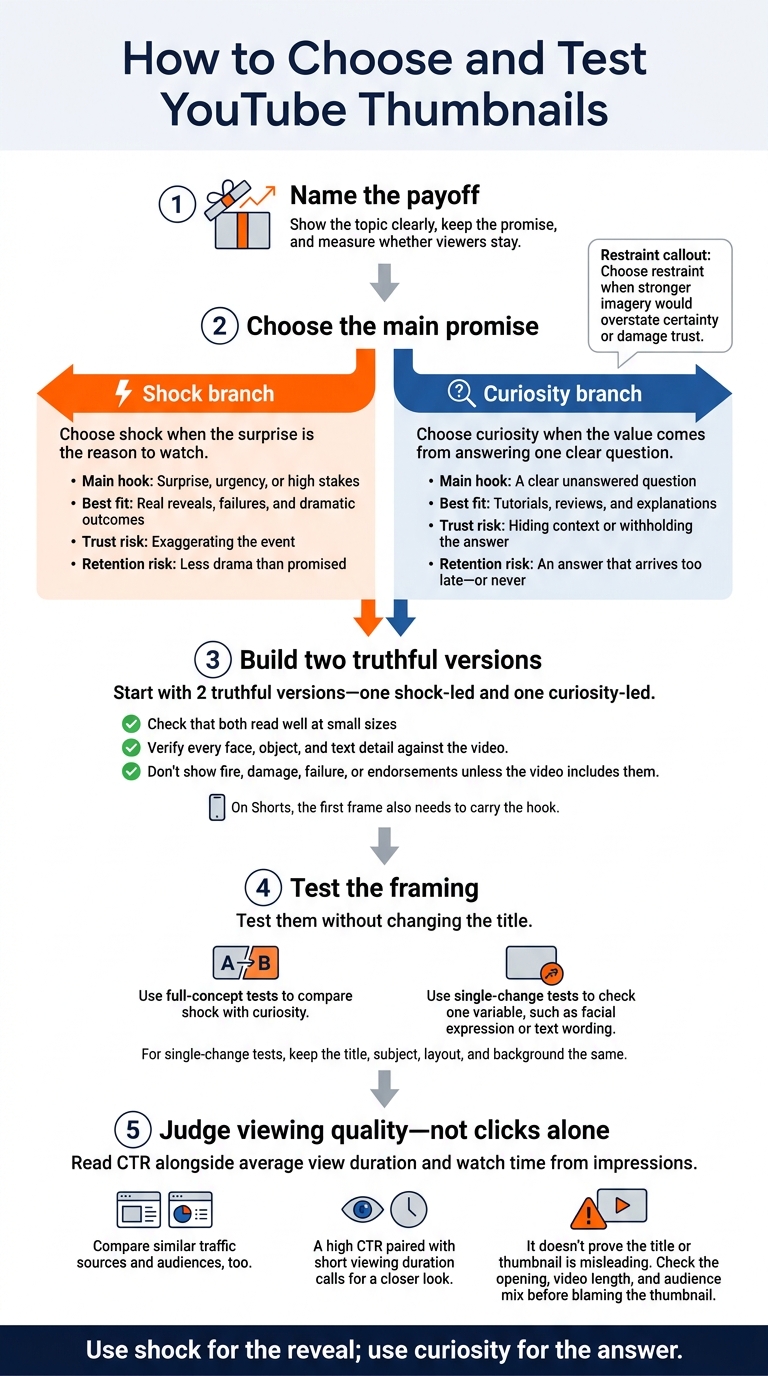
How to Choose and Test YouTube Thumbnails
Science Behind Thumbnails That Actually Work.
sbb-itb-b59debf
How Shock and Curiosity Affect Clicks, Trust, and Retention
Match the thumbnail’s trigger to what the video delivers, not just what might earn a click.
| Comparison factor | Shock-based thumbnails | Curiosity-based thumbnails |
|---|---|---|
| Initial clicks | Grabs attention, but doesn’t guarantee higher CTR | Can earn clicks with a relevant question |
| Perceived relevance | Must accurately show the event or outcome | Must match the video’s main question |
| Viewer trust | Exaggeration damages trust, especially in finance, news, health, and reviews | Unanswered promises damage trust in the same niches |
| Audience fit | Fits viewers seeking urgency, novelty, or intensity | Fits viewers seeking learning, discovery, or solutions |
| Retention risk | Higher when the video delivers less drama than promised | Higher when the answer is delayed or missing |
| Long-term channel value | Builds recognition through consistent coverage of real major events | Builds an evergreen identity around useful answers |
Shock: Surprise, Emotion, and Stakes
Shock works when a video has a real reveal, failure, or high-stakes outcome. It fits breaking news developments, transformations, unexpected results, and major failures.
Show the actual subject or outcome, and use the title and opening minute to explain what’s at stake. Repeated exaggeration can make even accurate uploads harder to trust.
If the payoff is an explanation rather than an impact, curiosity usually fits better.
Curiosity: A Clear Unanswered Question
Curiosity leaves one key piece missing: the cause, result, or explanation. Contrast or before-and-after tension can help pose that question. You can also split the answer across the title and thumbnail.
For tutorials, reviews, investigations, and evergreen explainers, hide the answer, not the context.
Before publishing, check that the title and thumbnail identify the topic and that the video answers the question. This match matters most when the answer itself is the reason to watch.
Why CTR Alone Is Not Enough
Read CTR alongside average view duration and watch time from impressions. Compare similar traffic sources and audiences, too. Search visitors and Home viewers may arrive with different intentions.
A high CTR paired with short viewing duration calls for a closer look. It doesn’t prove the title or thumbnail is misleading. Check the opening, video length, and audience mix before blaming the thumbnail. If you decide a redesign is necessary, follow an AI thumbnail generation guide to create more effective variations.
YouTube’s testing guidance uses watch time, rather than CTR alone, to evaluate packaging. Clicks support channel growth when they bring in viewers who stay.
Choose the Right Trigger for Your Content and Audience
Match the trigger to the video’s payoff. Shock works when a real event delivers the surprise. Curiosity works when viewers have a clear question they want answered.
| Content category | When shock fits | When curiosity fits | Accuracy and trust concerns |
|---|---|---|---|
| Short-form entertainment | A real reaction, stunt, transformation, surprise, or unexpected outcome | A setup that quickly reveals a trick, twist, or result | Don’t present staged reactions as spontaneous. |
| Commentary | A verified contradiction, dramatic development, or public reaction worth covering | An explanation of why something happened or what it means | Avoid outrage bait and misleading imagery, and opinions presented as facts. |
| News | A confirmed major development with immediate public importance | An investigation into causes, context, or what happens next | Avoid fabricated urgency, unverified claims, graphic imagery, or implied guilt. |
| Education | A surprising fact, experiment, mistake, or before-and-after result | A clear problem, puzzle, or explanation | Don’t oversimplify or claim results without support. |
| Finance | A verified market event, costly mistake, or unexpected financial outcome | Questions about risk, rates, investing, taxes, or decisions | Avoid guaranteed returns, fake losses, unsupported forecasts, and fear-based urgency. |
| Technology | An actual failure, technical breakthrough, unexpected benchmark, or dramatic teardown | Comparisons, hidden features, causes of failures, or buying decisions | Show actual results. Disclose testing limits, sponsorships, and outdated information. |
| Lifestyle | A visible transformation, surprising challenge, or unusual experience | Routines, experiments, travel discoveries, or “what happened when…” narratives | Don’t fabricate transformations or suggest personal results apply to everyone. |
Shorts autoplay, so the first frame must deliver the hook. Use the thumbnail for browse and channel surfaces where it appears.
If both triggers fit, use these three checks to choose one main promise.
3 Rules to Help You Choose
- Choose shock when the surprise is the reason to watch.
- Choose curiosity when the value comes from answering one clear question.
- Choose restraint when stronger imagery would overstate certainty or damage trust.
Make a Promise the Video Delivers
Use real failures for shock and real diagnoses for curiosity. The thumbnail must match what the video delivers.
Create and Test Thumbnail Variants
Once you’ve chosen the trigger, check how it looks on screen before publishing.
Build a Shock Version and a Curiosity Version
Use ThumbnailCreator to draft both versions quickly. Its AI drafts, templates, and text editing let you build variants fast. Then check readability at thumbnail size and verify every face, object, and text detail against the video. Face and object swaps must not suggest a false event, identity, or endorsement. The tool doesn’t predict which version will perform best or guarantee higher CTR.
Start with one truthful video promise. Frame it two ways: shock through surprise, urgency, or high stakes; curiosity through an unanswered question, partial reveal, or visual contrast.
Hypothetical treatments - not documented results. Each pair keeps the same video payoff.
Shared video promise Shock-led treatment Curiosity-led treatment “I tested whether a $20 kitchen gadget works” Wide-eyed reaction to an actual failure: “IT FAILED?” Gadget beside a partially hidden result: “Does It Work?” “I spent 24 hours in a freezing cabin” Frost, intense expression, and “NO HEAT” Open cabin door and thermometer: “Could I Last?” “I compared budget and premium running shoes” Close-up of actual shoe damage: “WORTH IT?” Both prices visible, performance result concealed: “Which Wins?” “I recreated a famous restaurant recipe” Reaction to a visibly failed dish: “DISASTER” Finished dish with one key step obscured: “The Missing Step”
Keep every treatment truthful. Don’t show fire, damage, failure, or endorsements unless the video includes them.
Test the two framings separately to see which attracts the right viewer.
Test Full Concepts and Single Changes Separately
Use full-concept tests to compare shock with curiosity. Use single-change tests to check one variable, such as facial expression or text wording. For single-change tests, keep the title, subject, layout, and background the same. Before each test, document the hypothesis, variant names, launch date, and unchanged elements.
Use YouTube Studio’s native testing when available. It supports up to three thumbnail or title options through thumbnail-only, title-only, or combined tests. Choose thumbnail-only testing to compare thumbnails without changing the title or video.
YouTube’s evaluation emphasizes watch time, not CTR alone. A “Winner” indicates stronger evidence; “Preferred” signals a less certain advantage; “None” means no clear winner. Allow enough impressions for the test to resolve. Without native testing, treat findings as directional rather than firm proof.
Track Viewing Quality and Channel Trends
Record impressions CTR, average view duration, watch time, traffic source, and the measurement window. Higher CTR paired with lower viewing duration can signal disappointed viewers.
Across comparable videos, track returning viewers, subscriber conversion, and sustained traffic - but don’t attribute those changes to thumbnails alone. Keep treatments that attract relevant clicks, sustain viewing, and protect trust.
Conclusion: Match the Thumbnail to the Payoff
After weighing both triggers, choose based on what the video delivers. Name the payoff first, then point the thumbnail toward it - not a bigger story the video doesn’t tell. This helps avoid the pitfalls of clickbait vs authentic thumbnails.
With that promise clear, test accurate versions to see which draws the right viewers. Look at CTR alongside view duration, retention, and returning viewers. A thumbnail should earn clicks and keep its promise, giving viewers a reason to stay and come back.
The strongest thumbnail previews the actual payoff and matches audience expectations. Use shock for the reveal; use curiosity for the answer.
FAQs
Can I combine shock and curiosity in one thumbnail?
Yes. Pair a high-contrast, shocking image, such as an extreme result, with an unexplained detail that sparks curiosity. The visual grabs attention; the missing detail gives viewers a reason to click. Make sure the video delivers on both so viewers can trust what you show them.
Should I update thumbnails on older videos?
Yes. Updating thumbnails on older videos can improve performance when you focus on clarity, honesty, and curiosity. Use ThumbnailCreator to make new versions that match your content and maintain viewer trust.
Leave the video unchanged and test one thumbnail element at a time, such as the crop, reaction, or text. This helps you measure how each change affects click-through rates and watch time.
How can I tell if my audience is tired of shock?
Compare your click-through rate (CTR) with audience retention. If your CTR is high but retention drops sharply, your shock-based thumbnail may promise something the video doesn’t deliver.
To check, use YouTube Studio to A/B test a shock-based thumbnail against a curiosity-based or value-driven version. If the curiosity-based version gets similar clicks but more watch time, that suggests your audience prefers clear, honest promises over artificial drama.