

Top 7 Thumbnail Copyright Cases Explained
A small image is not a free pass to use it. My starting point: check permission before publishing, then assess all 4 fair-use factors - purpose, type of work, amount copied, and market harm. U.S. law sets no safe pixel count or copying percentage.
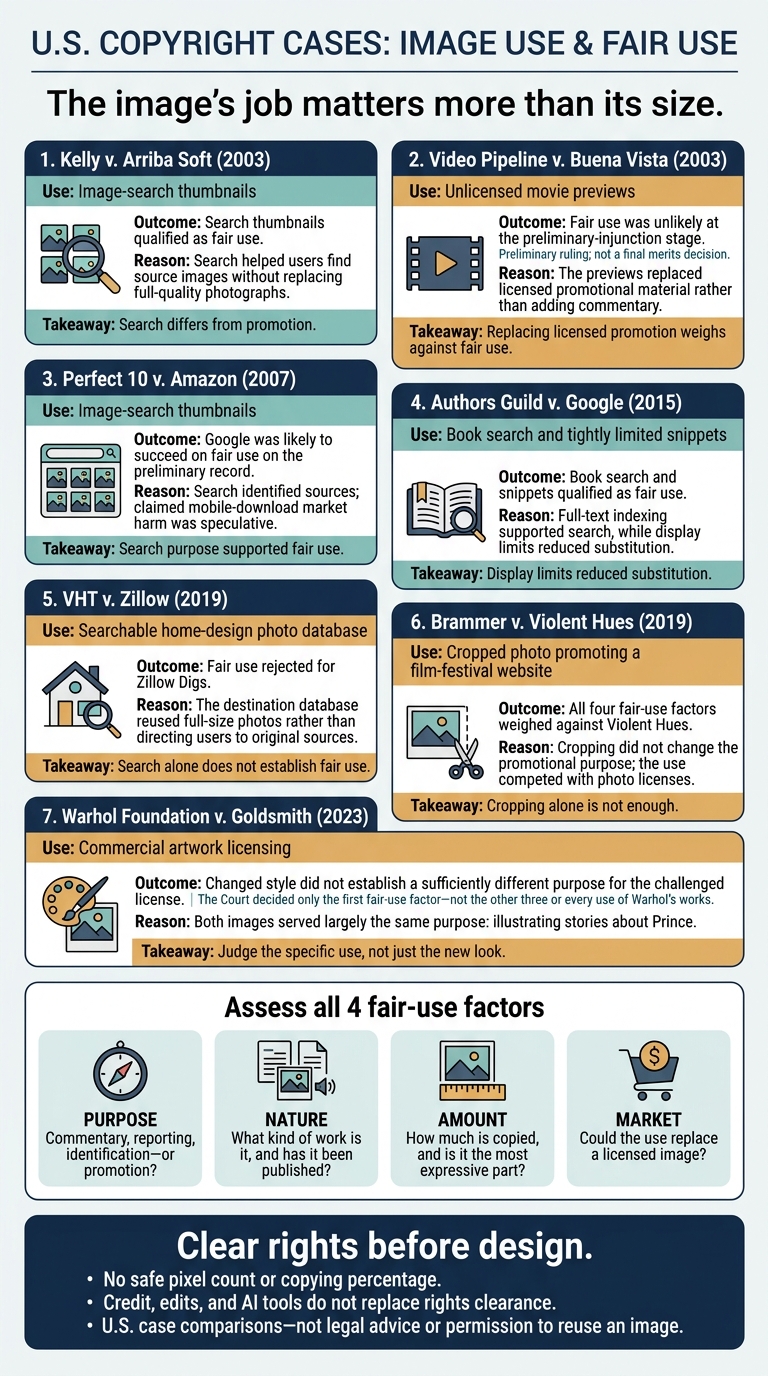
These 7 cases show why the image’s job matters more than its size:
- Kelly v. Arriba Soft (2003): Search thumbnails qualified as fair use - not blanket permission for video promotion.
- Video Pipeline v. Buena Vista (2003): Unlicensed movie previews were unlikely to qualify as fair use at the preliminary-injunction stage.
- Perfect 10 v. Amazon (2007): Google’s search thumbnails were likely fair use on the preliminary record.
- Authors Guild v. Google (2015): Book search with tightly limited snippets qualified as fair use.
- VHT v. Zillow (2019): A searchable photo database did not qualify merely because it offered search.
- Brammer v. Violent Hues (2019): Cropping a photo for a festival website did not establish fair use.
- Warhol Foundation v. Goldsmith (2023): A changed style did not settle the purpose question for a commercial image license.
Quick Comparison
| Case | Use examined | Main takeaway |
|---|---|---|
| Kelly | Image-search thumbnails | Search differs from promotion. |
| Video Pipeline | Movie previews | Replacing licensed promotion weighs against fair use. |
| Perfect 10 | Image-search thumbnails | Search purpose supported fair use. |
| Authors Guild | Book search and snippets | Display limits reduced substitution. |
| VHT | Home-design photo database | Search alone does not establish fair use. |
| Brammer | Cropped promotional photo | Cropping alone is not enough. |
| Warhol | Commercial artwork licensing | Judge the specific use, not just the new look. |
My takeaway: <u>clear rights before design</u>. Confirm that licenses cover YouTube promotion, save the terms, and document any fair-use reasoning. Credit, edits, and AI tools do not replace that check; people and logos may require separate review.
These are U.S. case comparisons, not legal advice or permission to reuse an image.
7 Copyright Cases: Purpose Matters More Than Image Size
The Lawsuit Over Thumbnail Images That Redefined Fair Use Online
sbb-itb-b59debf
Why Small Images Are Not Automatically Fair Use
Under 17 U.S.C. § 106, copyright owners control copying and public display. Saving an image and uploading it as a thumbnail can trigger both rights. Section 107 has no small-image safe harbor: no pixel count, file size, or crop percentage guarantees fair use. The risk depends on the full fair-use test, not image size alone.
Courts weigh the use’s purpose, the nature of the work, the amount used, and market harm. A low-resolution copy can still reproduce the entire image. A crop can still take the part that matters most.
In Perfect 10, Inc. v. Amazon.com, Inc. (2007), the Ninth Circuit found Google’s search-thumbnail use fair because the thumbnails served search indexing, not promotion. YouTube thumbnails usually serve a different function: promoting a video.
That difference matters in the cases that follow.
A crop, filter, or text overlay does not change the use if the image still serves as decoration or promotion. Does the thumbnail comment on the source, or does it mainly use the image to promote the video? Commercial promotion does not automatically rule out fair use. But showing a connection to commentary takes more than resizing the image.
Credit does not create rights. Attribution may meet a license’s requirements, but it does not replace permission. Check and save the original source’s terms - not just those on the page where you found the image. If you rely on fair use, document the thumbnail’s specific purpose, why you need that amount of the image, and whether a licensed promotional asset could replace it.
1. Kelly v. Arriba Soft Corp. (2003)
Photographer Leslie Kelly sued Arriba Soft after it copied 35 photographs and displayed low-resolution thumbnails in search results. In 2003, the Ninth Circuit held that creating and displaying those thumbnails was fair use. The key distinction: the thumbnails served as search results, not marketing or clickbait.
Kelly created his photographs for their visual and artistic content. Arriba used thumbnails to help users identify images and find their source pages. The court treated the amount copied as neutral: Arriba copied each whole image, but displayed it only as a thumbnail. The photographs’ creative nature weighed against fair use.
The thumbnails’ limited purpose and low resolution also shaped the court’s market-harm analysis. They helped users find photographs without replacing the full-quality originals. The court found no demonstrated harm to the photographs’ market or value.
Do not treat Kelly as permission to use a photo in a promotional thumbnail; the ruling turned on search indexing, not video marketing. That search-purpose distinction becomes narrower in the next case.
2. Video Pipeline, Inc. v. Buena Vista Home Entertainment, Inc. (2003)
Video Pipeline made two-minute movie previews for video retailers’ websites without permission. In 2003, the Third Circuit upheld a preliminary injunction against 62 previews, finding that Video Pipeline was unlikely to succeed on fair use. This was a preliminary ruling, not a final decision on the merits. The court viewed the previews as replacements for licensed promotional material, not commentary.
The clips added no new meaning or message. Calling them previews didn’t make them transformative - a point that works against thumbnails used only to promote a video.
Three fair-use factors weighed against Video Pipeline: its commercial, nontransformative use; the films’ creative nature; and market harm from replacing authorized trailers. Only the amount-used factor favored the company.
For those starting with YouTube thumbnails, the lesson has limits: this case concerned promotional videos, not thumbnails. A movie still needs a genuine critical or informational purpose to support that fair-use reasoning. Cropping the image or adding text doesn’t, on its own, turn promotional use into fair use.
3. Perfect 10, Inc. v. Amazon.com, Inc. (2007)
In 2007, the Ninth Circuit held that Google was likely to succeed on its fair-use defense for image-search thumbnails and vacated the preliminary injunction. Google used those images to point users to sources, not to replace the originals. The court viewed that reference use as transformative: the smaller images still showed enough detail to identify the source.
Perfect 10’s claim about harm to its mobile-download market was too speculative on the preliminary record. The court also would not presume market harm simply because Google’s use was commercial.
The server-test issue was separate. Google generally did not itself display the linked full-size images because third-party servers hosted and transmitted them.
For YouTube creators, the key question is whether an image adds commentary, reporting, or explanation - or simply drives clicks. Search thumbnails identify content; YouTube thumbnails usually promote it, often following specific YouTube thumbnail guides to maximize engagement. Google’s search use did not give others permission to reuse images for promotion. The next cases test how far that reasoning extends beyond image search.
4. Authors Guild v. Google, Inc. (2015)
While Perfect 10 treated search thumbnails as indexing tools, Authors Guild shows how strict display limits can support fair use. In 2015, the Second Circuit held that Google’s searchable book snippets were fair use: they helped users find text without replacing the book.
Google scanned copyrighted books and stored full-text copies for indexing. But users could see only short snippets around their search terms. The court viewed the search function as highly transformative and full-book copying as necessary for indexing. It evaluated the limited display separately.
The limits mattered. Google capped snippets and blocked enough page access to keep users from piecing together a readable copy. These safeguards supported the court’s finding that the snippets did not replace the books.
For thumbnails, copy only what the purpose requires, and ask whether the image could replace a licensed promotional asset for tutorials. Google’s snippet rules are not safe harbors for thumbnails.
The next case tests what happens when a use looks less like indexing and more like a substitute.
5. VHT, Inc. v. Zillow Group, Inc. (2019)
Unlike the indexing cases above, Zillow used photos to build and promote its own image database. VHT, a real-estate photography company, challenged that use. The court’s fair-use analysis centered on Zillow Digs, where Zillow deliberately reused and organized photos in a searchable database.
Zillow Digs was a destination database, not a reference tool. Zillow selected listing photographs, tagged them, and displayed full-size images in a searchable home-design database. In 2019, the Ninth Circuit rejected fair use for that database.
Digs searched Zillow’s own collection instead of directing users to original images elsewhere. The court stressed that calling a product a search engine does not make its use fair. The tags did not change the photos’ purpose, and the database risked replacing licensed photographs.
The lesson for thumbnail design is narrower: cropping or tagging does not change a use that still serves as a substitute. For YouTube creators, focus on the image’s role, not just your edits. A photo used as decoration or clickbait remains risky even when resized or labeled. To avoid these risks, study thumbnail strategies from successful channels that balance engagement with compliance.
6. Brammer v. Violent Hues Productions, LLC (2019)
VHT involved a search-style database. Brammer shows how the same fair-use limits can apply to a single promotional image. Russell Brammer took Adams Morgan at Night in 2011 and posted it on Flickr with a copyright notice. Violent Hues Productions copied and cropped the image, then used it without permission on a website promoting the Northern Virginia Film Festival. In 2019, the Fourth Circuit reversed the lower court’s decision and held that all four fair-use factors weighed against Violent Hues.
The court found the use non-transformative: cropping the photo and adding a caption did not give it a new meaning, message, or purpose. It also treated the website as commercial because it promoted a revenue-generating film festival. The photograph’s high degree of creativity gave it strong copyright protection.
Violent Hues copied about half of the photograph, keeping its most expressive features. Brammer had licensed the image online for $750 and $1,250. Those licenses supported the court’s finding of market harm, even without proof of a specific lost sale. The effect on the licensing market deserves close attention from thumbnail creators. This is especially true when analyzing trending YouTube thumbnails for visual inspiration.
For thumbnails, a smaller crop alone does not establish fair use when an image promotes a video. Before publishing, confirm that you have permission and that the license covers thumbnails and commercial promotion. Save the license terms, too.
7. Andy Warhol Foundation for the Visual Arts, Inc. v. Goldsmith (2023)
Warhol sharpens the earlier cases: a new look does not automatically create a new purpose. For thumbnails, changing the style alone does not turn promotional use into fair use.
Lynn Goldsmith photographed Prince in 1981. In 1984, her agency licensed one black-and-white Prince photograph to Vanity Fair for one-time use as an artist reference for an illustration.
Vanity Fair commissioned Warhol to create that illustration using Goldsmith’s photo. In 2016, the Warhol Foundation licensed Orange Prince to Condé Nast for a Prince commemorative magazine. The Court reviewed that later commercial license - not the creation of the original artwork. In that context, both images served largely the same purpose: illustrating stories about Prince. The changed appearance did not establish a sufficiently different purpose.
The Court decided only the first fair use factor: purpose and character. It did not decide the other three factors or rule that every use of Warhol’s works is unlawful.
For thumbnails, focus on what the image does. Document its purpose and whether its use is promotional or monetized. Apply that same purpose-first approach in the four-factor check below.
Check Your Thumbnail Against the 4 Fair-Use Factors
The cases above turn on the same four factors. Use them to check whether your thumbnail adds meaning or just borrows attention. Search use, commentary, and substitution come up repeatedly. The distinction is whether you’re using an image as evidence or commentary - or simply as clickbait vs authentic thumbnails.
Purpose: Commentary or Promotion?
Start with the thumbnail’s job, not the video’s. Describe the image’s role in one sentence: commentary, reporting, identification, or promotion. Make sure the thumbnail’s claim matches what the video actually covers.
Nature: What Kind of Work Are You Using?
Identify what you’re using: a photo, illustration, film still, or artwork. Also note whether it has been published. Both the type of work and its publication status affect the thumbnail’s fair-use risk.
Amount: How Much Do You Need to Copy?
Look at both how much you copy and which part you take. Even a small crop can contain the image’s most expressive part. Document why your chosen crop and resolution are enough for the thumbnail’s purpose.
Market: Could Your Use Replace a Licensed Image?
Substitution is the strongest risk signal. Check whether the image is licensed for editorial, promotional, or thumbnail use - and whether your version could replace a licensed promotional image. If the image mainly provides a promotional visual that would normally require a license, get permission instead.
Comparison Table: The 7 Cases
Use this table as a risk guide, not permission. None of these cases gives blanket approval for thumbnails; each depends on its facts. Thumbnail risk turns on purpose and market effect - not image size.
The pattern is straightforward: search and commentary fare better than promotion and substitution.
| Case | Image use | Why it mattered | Market risk | What to do |
|---|---|---|---|---|
| Kelly v. Arriba Soft Corp. (2003) | Search indexing. | Search served a different purpose from displaying art. | Previews did not replace full-size photos. | Do not treat video promotion as image indexing. |
| Video Pipeline, Inc. v. Buena Vista Home Entertainment, Inc. (2003) | Film promotion. | The previews lacked a new purpose; fair use was unlikely on the preliminary record. | Competition with authorized promotional material. | Check permission before using entertainment imagery for promotion. |
| Perfect 10, Inc. v. Amazon.com, Inc. (2007) | Image discovery. | Search helped users find sources. | Claimed harm to the thumbnail market was speculative on the preliminary record. | Separate copying from linking; search use does not permit promotional reuse. |
| Authors Guild v. Google, Inc. (2015) | Book discovery. | Search added a function while limiting access. | Limited substitution for books. | Assess purpose, amount, and market effect - not size alone. |
| VHT, Inc. v. Zillow Group, Inc. (2019) | Commercial database use. | Zillow reused photos in its own database instead of directing users to sources. | Competition with licensed photographs. | Check that photo licenses cover commercial thumbnail use. |
| Brammer v. Violent Hues Productions, LLC (2019) | A cropped photo promoted a film-festival website. | Cropping did not change the promotional purpose. | Competition with photo licenses. | Cropping does not create a new purpose. |
| Andy Warhol Foundation for the Visual Arts, Inc. v. Goldsmith (2023) | Commercial image licensing. | A different style did not change the challenged licensing purpose. | Overlap with the photographer’s licensing market. | Judge the use, not the style; a restyled commercial thumbnail can still replace licensed photography. |
No case sets a safe pixel count or copying percentage. For high-risk commercial uses, consult U.S. copyright counsel.
Use these patterns to check your image-rights workflow below. If you need to create new assets, see our free thumbnail tools guide for safe resources.
A Thumbnail Workflow That Checks Image Rights
The cases point to a simple rule: document rights before you publish. Turn the lessons above into a clearance workflow before design begins.
Choose Assets and Check License Terms
Choose original, public-domain, or licensed assets. For commissioned work, get the rights in writing. Verify public-domain status, and confirm that whoever grants permission owns the image or holds a license that lets them grant those rights. Owning the page where you found it isn’t enough.
Make sure the permitted uses cover YouTube thumbnails, monetized videos, promotional reuse, global distribution, and edits. Check attribution requirements, editorial-only restrictions, expiration dates, and whether coverage continues after a subscription or trial ends.
Keep a rights log with the source URL, asset ID, download date, license version, attribution terms, receipt, and permission emails.
Record Your Fair-Use Reasoning
If a license is unclear, document your fair-use reasoning before editing. Write a short note for each asset covering its purpose, source type, amount used, and market risk. Save the note with the file, along with alternatives you considered and any concerns.
This note helps you make a decision; it’s not protection against a claim. Consult U.S. copyright counsel when the stakes warrant it.
Separate Design Tools From Rights Clearance
Design tools help you produce thumbnails faster, but they don’t replace rights clearance. ThumbnailCreator helps with design; it does not clear rights to any asset, font, face, logo, or output.
Read its terms and check the rights for every input and result. AI generation does not make the result rights-safe. If you swap a face or object, review the source assets and the resulting composition again.
For recognizable people, check publicity and endorsement rights. A photographer’s permission doesn’t automatically settle those rights. Review logos for misleading suggestions of sponsorship or affiliation, and check license restrictions.
Confirm that the thumbnail accurately represents the video and follows YouTube’s thumbnail policy. Resolve issues involving people, logos, and source images before uploading. Replace any assets with unresolved rights before publishing.
Conclusion: Case Rulings Are Not Blanket Permission
These cases point to the same distinction: a favorable ruling for discovery uses does not give blanket permission for promotional thumbnails. Discovery uses may support search or identification. But a YouTube thumbnail designed to earn clicks may serve the image’s original promotional purpose or replace a licensed image.
Cropping, filters, and text overlays do not, by themselves, change that purpose. A fair-use argument based on commentary is stronger when you copy only what you need. Ask whether the image supports your message or simply adds visual appeal.
The four factors still govern the analysis. Fair use depends on the facts of each case - not a rule based on image size or platform.
This article is educational, not legal advice; creators facing a takedown, demand, lawsuit, or sponsorship dispute should consult a qualified U.S. copyright attorney.
FAQs
Can my review thumbnail qualify as fair use?
A review thumbnail may qualify as fair use, but there’s no guarantee. Fair use is a defense against a copyright claim - not permission granted in advance. Courts weigh four factors: the use’s purpose and character, the original work’s nature, how much you use, and the effect on the work’s market.
Your case is strongest when the thumbnail is transformative: it adds commentary, criticism, or a new message rather than simply drawing clicks. Using only the portion needed for your critique also helps support your case.
What should I do if my thumbnail gets a copyright claim?
Save screenshots of the notice, your YouTube dashboard, and any related emails. Replace the flagged thumbnail right away with plain text or artwork you clearly created yourself while you look into the claim.
Review your rights log to confirm that every asset license explicitly permits commercial use and modifications. If you think the claim is wrong or fair use applies, speak with legal counsel before filing a formal counter-notification. This is a legal statement made under penalty of perjury.
Can I use a Creative Commons image in a monetized thumbnail?
Yes - if the license allows commercial use. Monetization counts as commercial use, so skip licenses with a NonCommercial (NC) restriction.
CC0, CC BY, and CC BY-SA are the safest options because they allow commercial use and modifications. Avoid CC BY-ND, which prohibits sharing edited versions, such as images with cropping or added text.
Always check the license on the original source page and give attribution when required.