

Can You Use Celebrity Photos in Thumbnails?
Yes - but for most YouTube creators, it’s risky. If I use a celebrity photo in a thumbnail, I may run into three separate problems at once: photo copyright, the celebrity’s publicity rights, and YouTube’s own rules.
Here’s the short version:
- Finding a photo on Google, Instagram, or X does not make it free to use
- A photo license may cover the image but not the celebrity’s face
- Fair use is not automatic, and thumbnails face a tough test because they help drive clicks, often blurring the line between clickbait and authentic thumbnails
- Copyright damages can range from $750 to $30,000 per work, and up to $150,000 for willful infringement
- State publicity-right claims can add more legal risk
- YouTube can still remove the thumbnail even if I think the use is legal
If I want the low-risk path and want to avoid common thumbnail mistakes, I should use my own thumbnail art, licensed visuals with the right terms, or a design that does not rely on a celebrity photo.
A fast way to think about it: copyright protects the photo, publicity rights protect the person, and YouTube protects the platform. I have to clear all three, not just one.
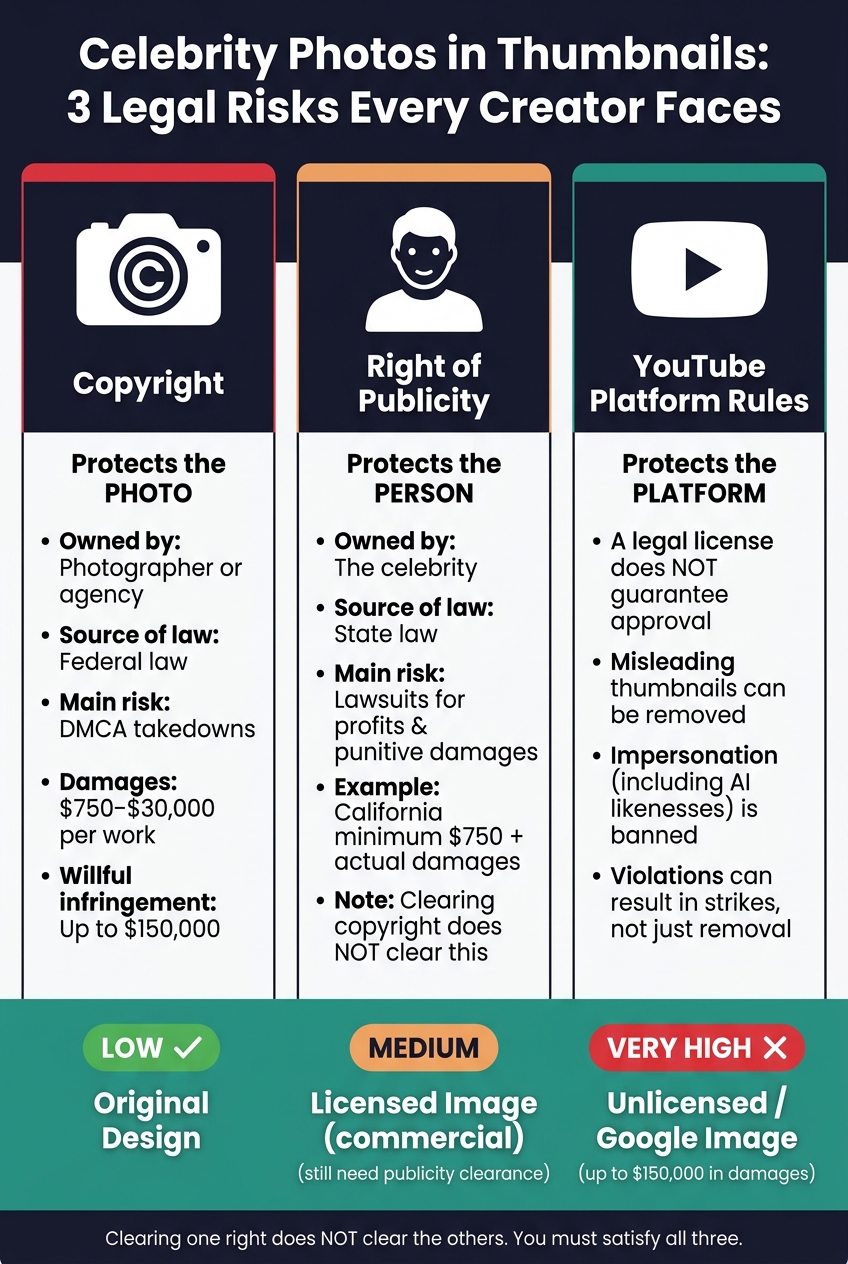
Celebrity Photos in Thumbnails: Copyright vs. Publicity Rights vs. YouTube Rules
How to Legally Use Free Images of Famous People in Videos – No Copyright Issues!
sbb-itb-b59debf
When Using a Celebrity Photo Is Risky or Allowed
Using a celebrity photo can get tricky fast because two separate rights may be in play at the same time: the photo itself and the person’s likeness.
Copyright Usually Belongs to the Photographer or Agency
In most cases, the copyright belongs to the photographer or, under work-for-hire rules, their employer.
That means if you use a celebrity photo without permission, you may be dealing with copyright infringement. And that can get expensive. Statutory damages range from $750 to $30,000 per work, and can go as high as $150,000 for willful infringement.
One thing trips people up here: clearing one right does not clear the other.
A Celebrity's Likeness Can Create Separate Legal Issues
Even if you have permission to use the photo from a copyright standpoint, that does not mean you're free to use the celebrity’s name, face, or identity in a commercial way.
That part falls under the right of publicity. Unlike copyright, this is based on state law, not federal law.
For thumbnails, the big issue is commercial use. If the thumbnail image doesn’t match the actual video content, a court may see it as a commercial use that has little to do with the video itself. That can make the risk much higher.
California is a good example. There, unauthorized commercial use of a living person’s likeness can lead to damages of at least $750, plus actual damages and profits.
Here’s the split at a glance:
| Copyright | Right of Publicity | |
|---|---|---|
| Who owns it | Photographer or agency | The celebrity |
| Source of law | Federal law | State law |
| What it protects | The photo as a creative work | The celebrity's identity and likeness |
| Main risk | DMCA takedowns, statutory damages | Lawsuits for profits and punitive damages |
Fair Use and Other Narrow Exceptions
If you don't have permission, the next narrow issue is fair use. It can apply, but it's never automatic. Courts look at four factors: purpose, nature of the original, amount used, and market effect. There is no rule that guarantees fair use. And even if fair use covers the photo, that still doesn't clear publicity rights. A fair use defense for the image does not, by itself, protect a celebrity's likeness.
Cases Where Commentary, Criticism, or Parody May Help
Commentary, criticism, and parody can make a fair use argument stronger. In Hannley v. Mann, a U.S. District Court held that use of a copyrighted photo in a YouTube thumbnail was fair use because the thumbnail helped deliver negative criticism, not self-promotion. In Santos v. Kimmel, the Second Circuit affirmed in 2025 that Jimmy Kimmel's use of George Santos's Cameo videos was transformative because it conveyed a different message from the source material.
The key issue is transformation. A work is transformative when it adds a new purpose, meaning, or message. This often involves experimenting with different YouTube thumbnail styles to create a unique visual identity. If the image only serves to identify the celebrity, it is not transformative. For thumbnails, that's the heart of it. The image has to do more than say, "this video is about that person." The criticism or satire needs to come through in the thumbnail itself, not just in the video it links to.
Why Fair Use Is Not a Safe Default for Thumbnails
Fair use is a shaky default for thumbnails. Thumbnails are promotional by nature, and a filter, crop, or text overlay won't turn a copied celebrity image into something transformative. As YouTube's own guidance states:
"There aren't any magic words to automatically apply fair use when you use someone else's copyrighted work."
The Ninth Circuit made a similar point in McGucken v. Pub Ocean Ltd.:
"Exploiting the beauty and intrigue of... photos... without adding anything new is not transformative."
So if a thumbnail is getting clicks mainly because of a celebrity's face, instead of making a clear point about that image, a fair use defense is less likely to hold up. When the answer is murky, the safer move is licensed art or original thumbnail designs.
Safer Ways to Build a Thumbnail
Use Licensed or Properly Cleared Images
If you still want to use a celebrity image, start with clearance, not a random image from search results.
Licensing is the safest place to begin. But here's the catch: a license by itself may not be enough. You may still need publicity clearance for the celebrity's likeness.
Also, treat "Editorial Use Only" images as off-limits for promotional thumbnails. Those images aren't meant for marketing use. A commercial license can allow promotional use, but it still doesn't clear the celebrity's likeness rights.
Use Original Designs Instead of the Celebrity Photo
The simplest way to avoid this issue is to skip the celebrity photo altogether.
Text-led designs, symbolic graphics, and original photography can still show what a video is about without using someone else's face or a photographer's copyrighted image. You can also browse trending thumbnails for inspiration on layouts that don't rely on celebrity likeness. In plain English: you can make a strong thumbnail without stepping into a legal mess.
ThumbnailCreator's AI generation, templates, text editing, and object swapping can help you build original thumbnails without third-party photos.
Licensed vs. Fair Use vs. Unlicensed: A Quick Comparison
When you're choosing how to build a thumbnail, the gap between these three options comes down to risk, cost, and control:
| Feature | Licensed Use | Fair Use (Defense) | Unlicensed Use |
|---|---|---|---|
| Legal Risk | Low (if terms are followed) | High (case-by-case) | Very High |
| Control | High (contractual certainty) | Low (subject to court) | None |
| Cost | Upfront fee (hundreds to thousands) | $0 initially | Unlicensed use can lead to statutory damages of up to $150,000 per work |
That’s why original design or properly licensed art is usually the safer default.
Even if your thumbnail is cleared, it still has to follow YouTube's thumbnail rules.
YouTube Rules and a Final Publishing Checklist
YouTube's Thumbnail Rules Still Apply
Even if an image is cleared, it still has to meet YouTube's own rules. A legal license for a celebrity photo does not guarantee that YouTube will approve the thumbnail. The platform can still remove it or age-restrict it if it breaks Community Guidelines, even when the image is fully licensed.
The thumbnail also can't mislead people. If the celebrity doesn't play a meaningful role in the video, YouTube may remove the thumbnail for misleading viewers.
YouTube also bans impersonation. That means you can't use a celebrity's likeness in a way that makes people think the channel is owned by, connected to, or approved by that person. This applies to AI-generated likenesses too.
"YouTube does not allow unauthorized impersonation of a person, entity, or channel that may mislead viewers in a way that could harm the YouTube community." - YouTube Help
And there’s another risk here: a copyright dispute can still lead to removal or even a strike, which is more serious than a standard content notice.
Checklist Before You Publish
Use this quick check before you upload.
| Check | What to Confirm |
|---|---|
| Rights | Do you own the image, or do you have a valid commercial license that allows promotional use? |
| Publicity Rights | Does the celebrity's face suggest an endorsement or approval you don't actually have? |
| Fair Use Necessity | If you don't have a license, is the image strictly needed for criticism or commentary instead of serving as visual filler? (See our YouTube thumbnail ideas for creative alternatives.) |
| Accuracy | Does the thumbnail match what the video actually covers? |
| Community Guidelines | Does the image avoid nudity, hate speech, and graphic violence? |
| Documentation | Have you saved the source URL, license terms, download date, and invoice or order ID? |
Key Takeaways
Copyright covers the photo itself. The right of publicity covers the celebrity's likeness. Clearing one does not clear the other.
Copyright infringement can lead to statutory damages of $750 to $30,000 per work, and up to $150,000 for willful infringement. Publicity-right claims can add a separate layer of legal risk.
Fair use may help in some cases, but it is a defense, not permission. It depends on the facts of the case, and commercial thumbnails face a higher bar.
The practical default is to make your own thumbnail. The safest path is an original thumbnail, and you can compare thumbnail tools to find the best design approach. Original designs give you full control over the design. ThumbnailCreator can help you build an original thumbnail fast.
If you use a licensed image, keep your records close at hand:
- Source URL
- License terms
- Download date
- Invoice
FAQs
Can I use a celebrity photo if I credit the source?
No. Crediting the source does not give you the legal right to use a celebrity photo in your YouTube thumbnail.
Copyright and the right of publicity are separate. In most cases, you need permission from the copyright holder and the celebrity’s consent, especially when the thumbnail is used for commercial or promotional purposes. Without both, you could face copyright strikes or lawsuits.
Does a photo license also cover the celebrity’s face?
No. A photo license covers the image’s copyright. It does not cover the celebrity’s right of publicity.
So even if you license the photo from an agency, you’ll usually still need separate permission, such as a model release, if you want to use that person’s likeness for commercial or promotional purposes.
Can YouTube remove a legal celebrity thumbnail?
Yes. YouTube can remove a celebrity thumbnail if it breaks copyright rules or Community Guidelines.
For example, a thumbnail may be taken down after a copyright complaint. The same can happen if the image is sexually suggestive or otherwise inappropriate.
If you use celebrity photos without permission, YouTube may also issue removals, warnings, or channel strikes.